Demo Environment — Sample Municipality Only. The Municipality of Daet, Camarines Norte is used here as a sample municipality for demonstration purposes only. All household profiles, statistics, geographic data, and analytics shown in this platform are purely fictional and computer-generated — they do not represent real residents, families, or government records. No actual personal or household data has been collected or stored.

Municipality of Daet
Powered by Syntrapolis

Know Your Community. Govern With Confidence. Pass Every Audit.
SyntraPolis gives every LGU official a clear, real-time view of household conditions across all 25 barangays, so decisions are based on updated data instead of assumptions.
Stop Governing in the Dark.
Missing SGLG benchmarks or failing an ARTA audit often happens when decisions rely on outdated paper records. SyntraPolis helps prevent this.
Bulletproof Resource Allocation
Plan project budgets with confidence. Every request, from farm-to-market roads to 4Ps distribution, is supported by verified and traceable household data.
Seamless DILG & SGLG Compliance
Meet policy requirements without last-minute pressure. Easily monitor and demonstrate your LGU’s performance using updated governance data.
Zero Duplication Amelioration
Avoid duplicate or ineligible beneficiaries across AICS, senior grants, and Listahanan. The centralized registry ensures assistance goes only to qualified families.
Geospatial Hazard Defense
Identify which households are at risk from disasters such as typhoons or landslides before they happen. This helps prove your LGU’s disaster readiness.
Unified Executive Command
Connect all departments into one system with real-time data. Each office has proper access, while leaders maintain a complete and reliable overview of the municipality.
Problems Every LGU Knows.Solutions Only SyntraPolis Delivers.
Each story below is drawn from real PSA CBMS limitations — gaps that SyntraPolis was specifically built to close.
“A budget mapped on obsolete data is a budget destined for COA scrutiny.”
- Situation
- Populations shift. People are born, people pass away, and families relocate. Yet, when securing budget allocations, most units are forced to use obsolete data.
- Complication
- Auditors and constituents are demanding proof of impact, but you are distributing aid to names that might not even live in that barangay anymore.
- Question
- How can you justify multi-million peso programs when your baseline reality is years out of date?
- SyntraPolis Answer
- The platform continuously syncs enumerator field data instantly. You get today’s exact demographic reality to justify every single peso spent.
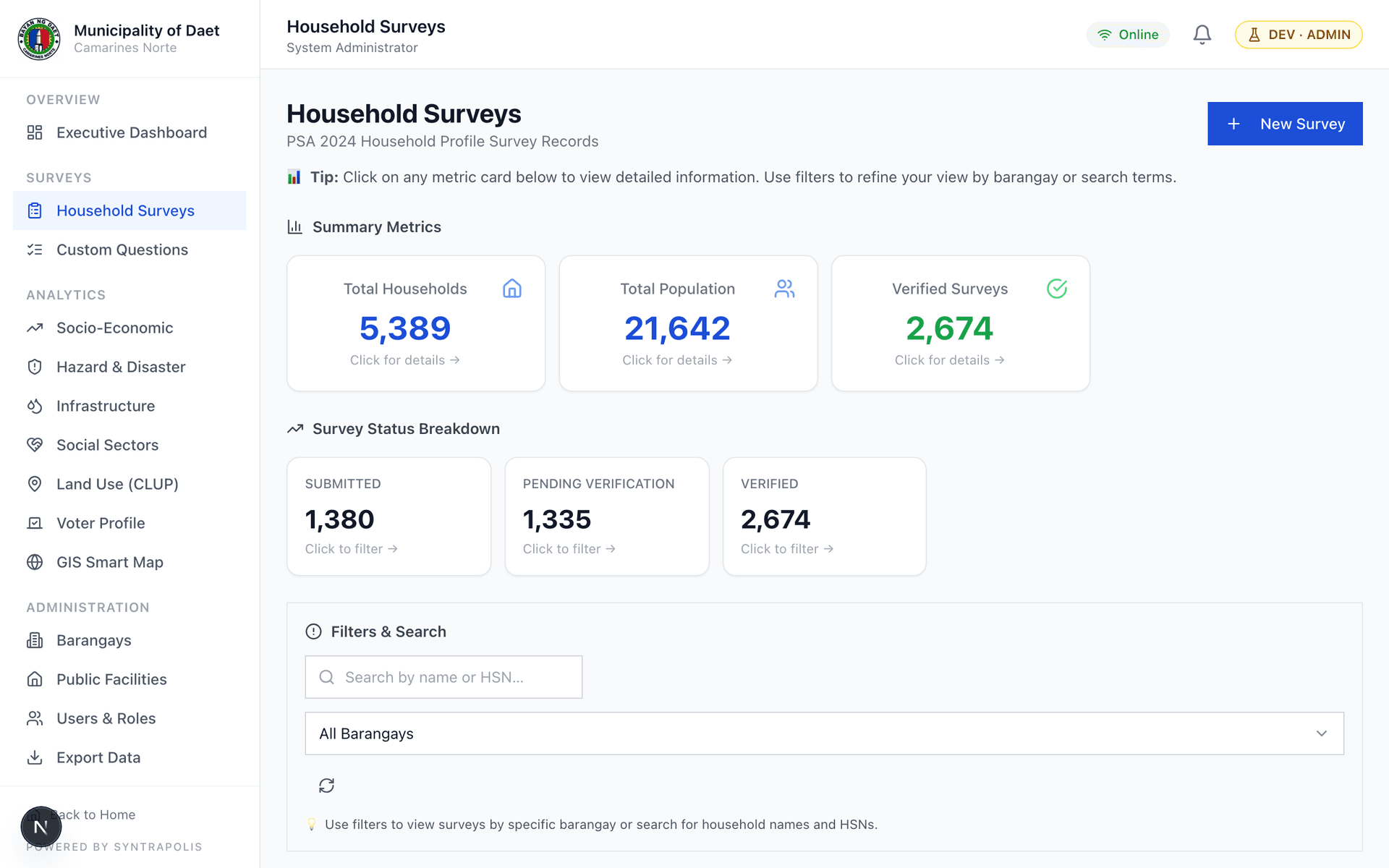
Built for LGU Reality
Six focused capabilities — each addressing a real governance challenge faced by municipal executives and department heads.
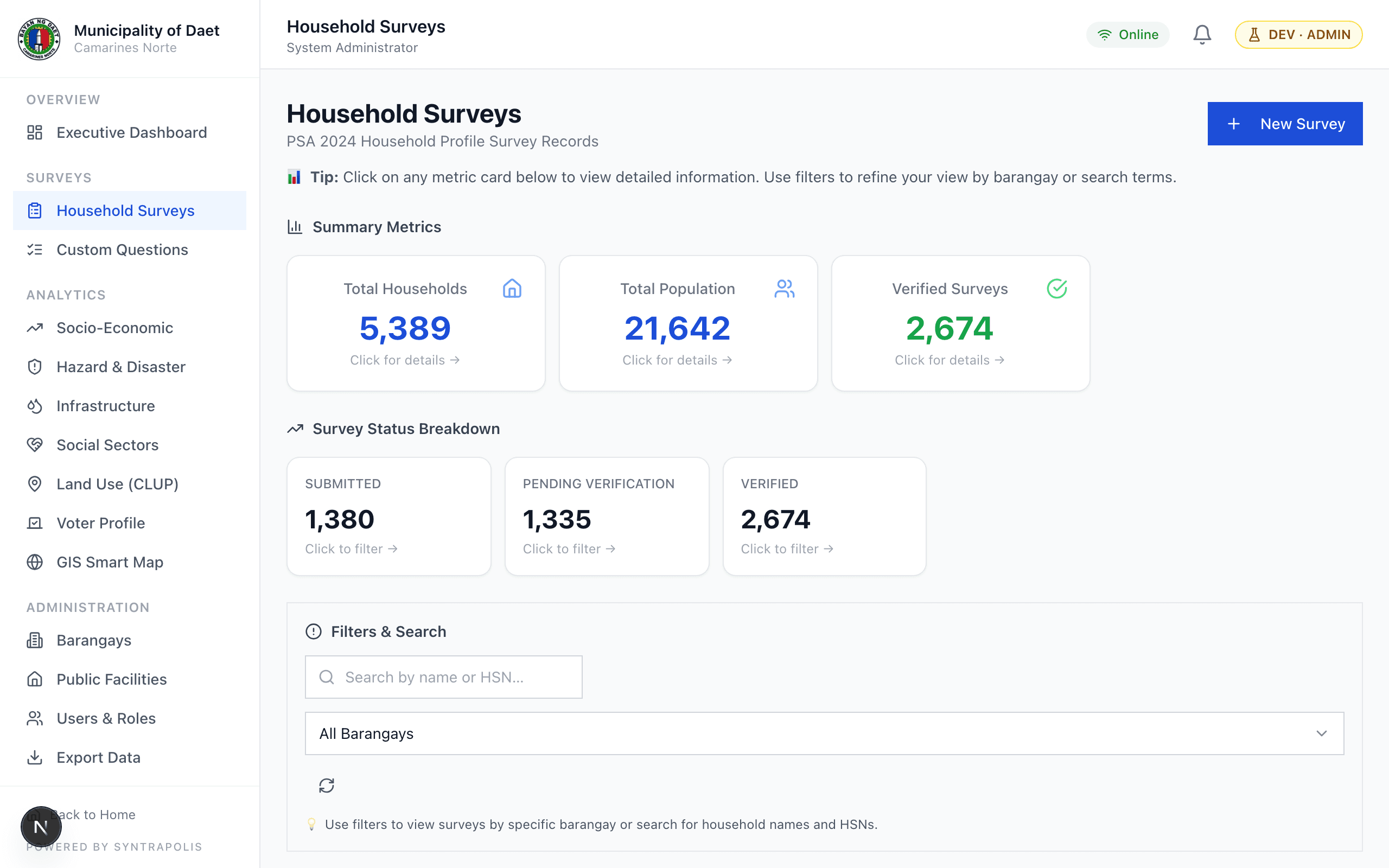
Household Profiling at Scale
Every family, accurately counted.
Field teams can collect standardized data even without the internet. Information is saved and automatically uploaded once connected, ensuring no household is missed.
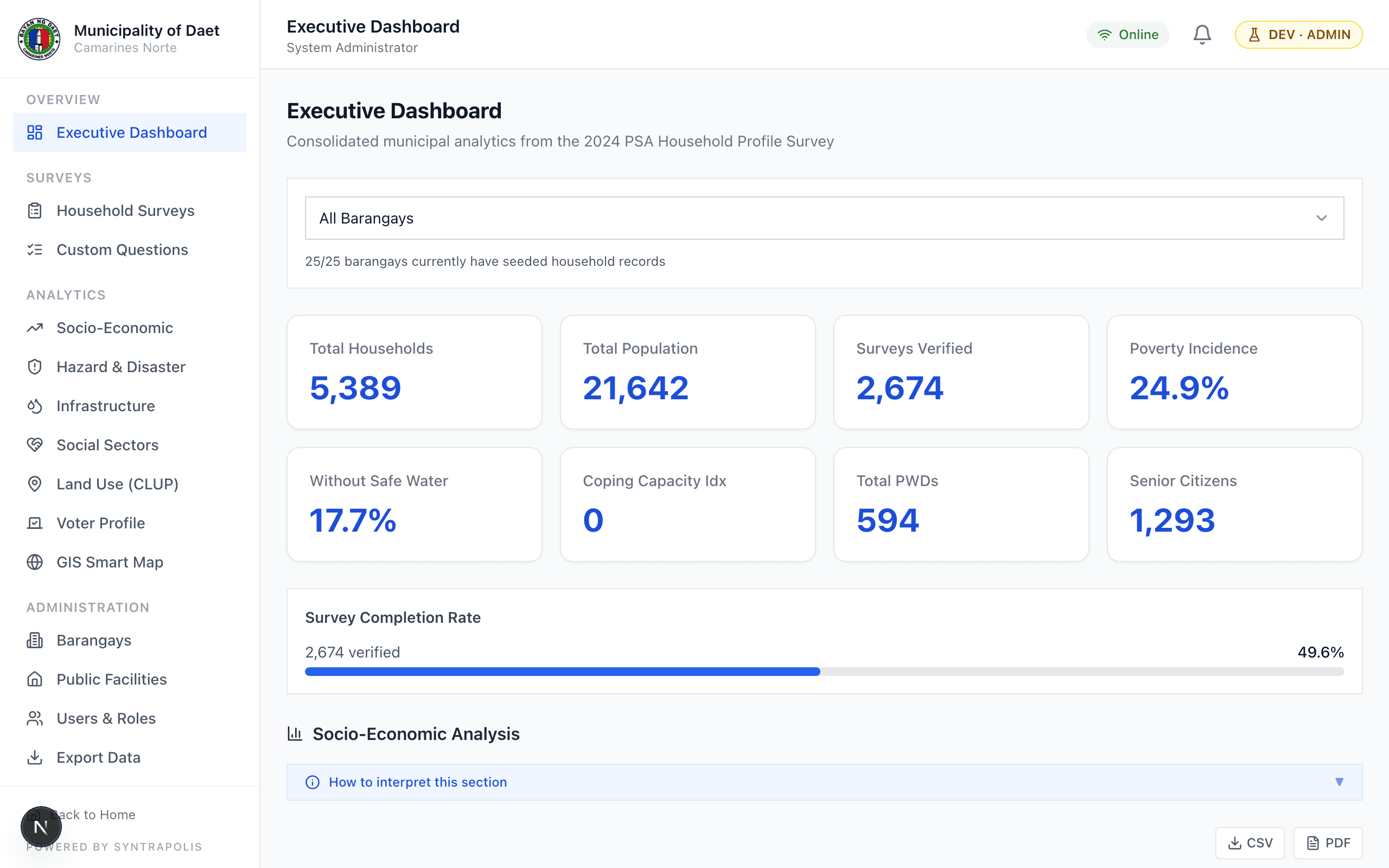
Executive Command Dashboard
One screen. Full picture.
View real-time data on poverty, water access, housing, and 4Ps coverage by barangay. The system is designed for quick understanding, not complex spreadsheets.
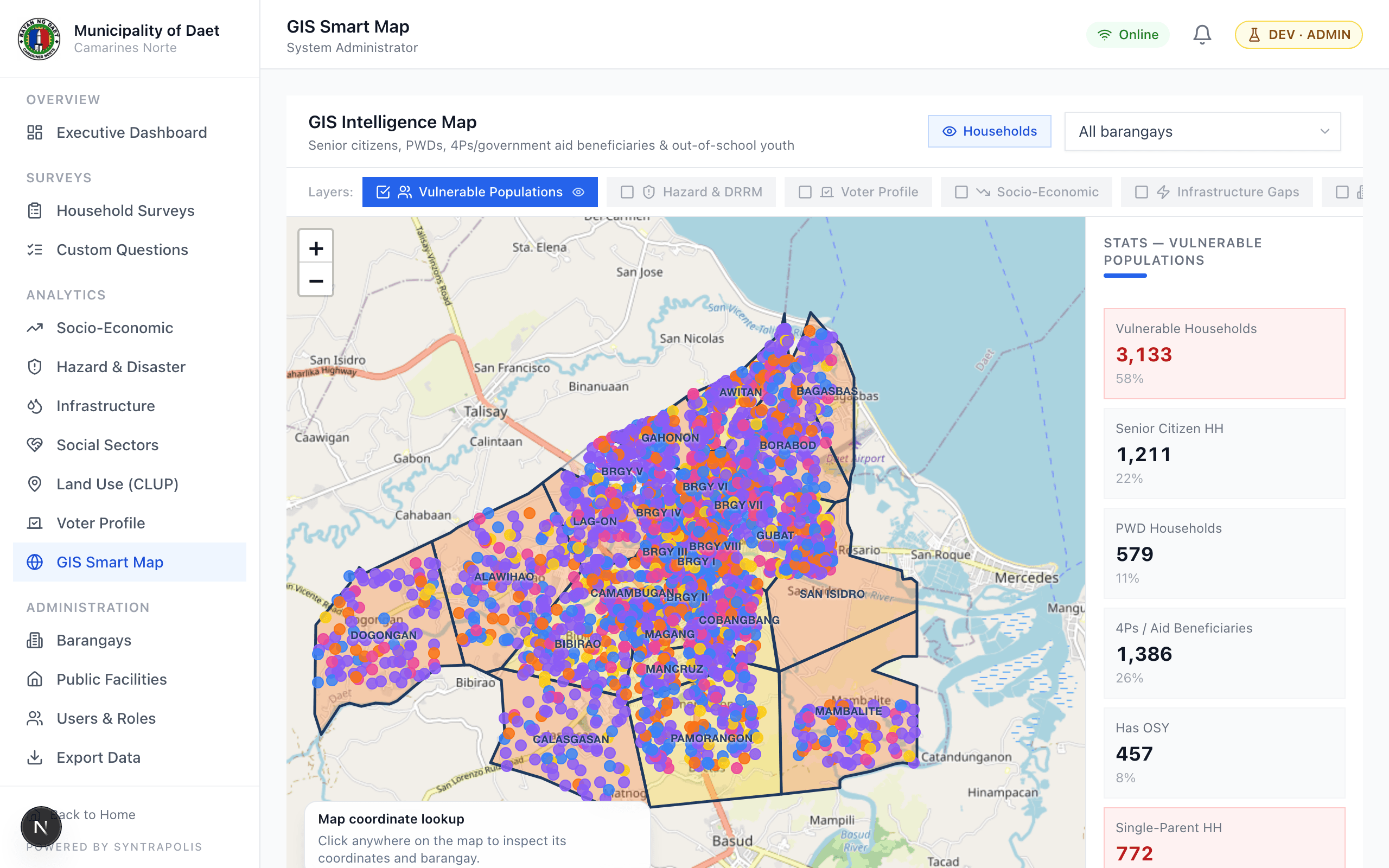
Live GIS Mapping
See problems on a map, not a table.
Interactive maps show flood-prone areas, informal settlements, and service gaps. This helps translate data into clear planning decisions for land use and disaster management.
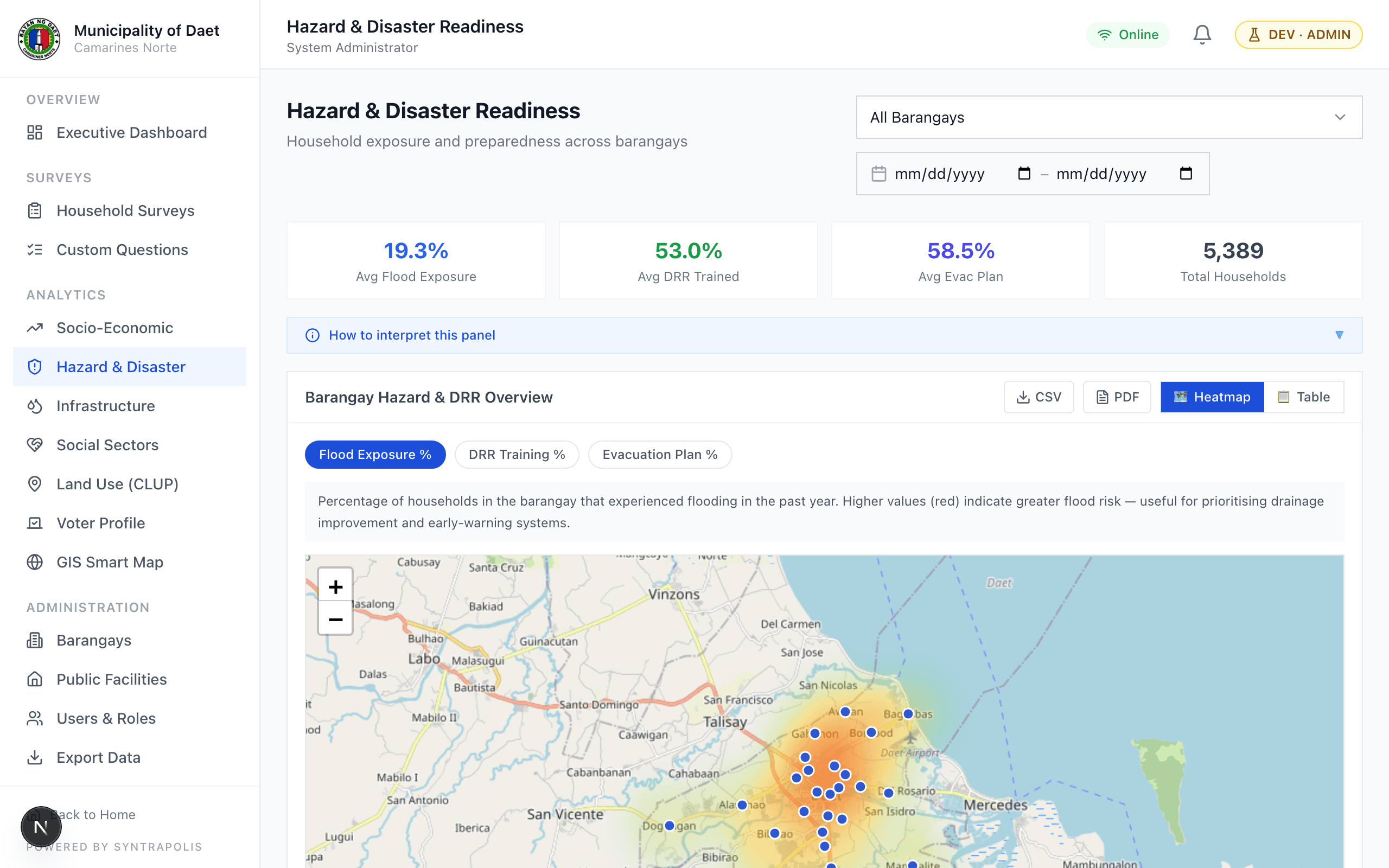
DRRM Readiness Tracker
Know who is prepared before the typhoon hits.
Per-household tracking of evacuation plans, emergency kits, DRRM training, and shelter awareness — so responders know exactly where to focus when it matters.
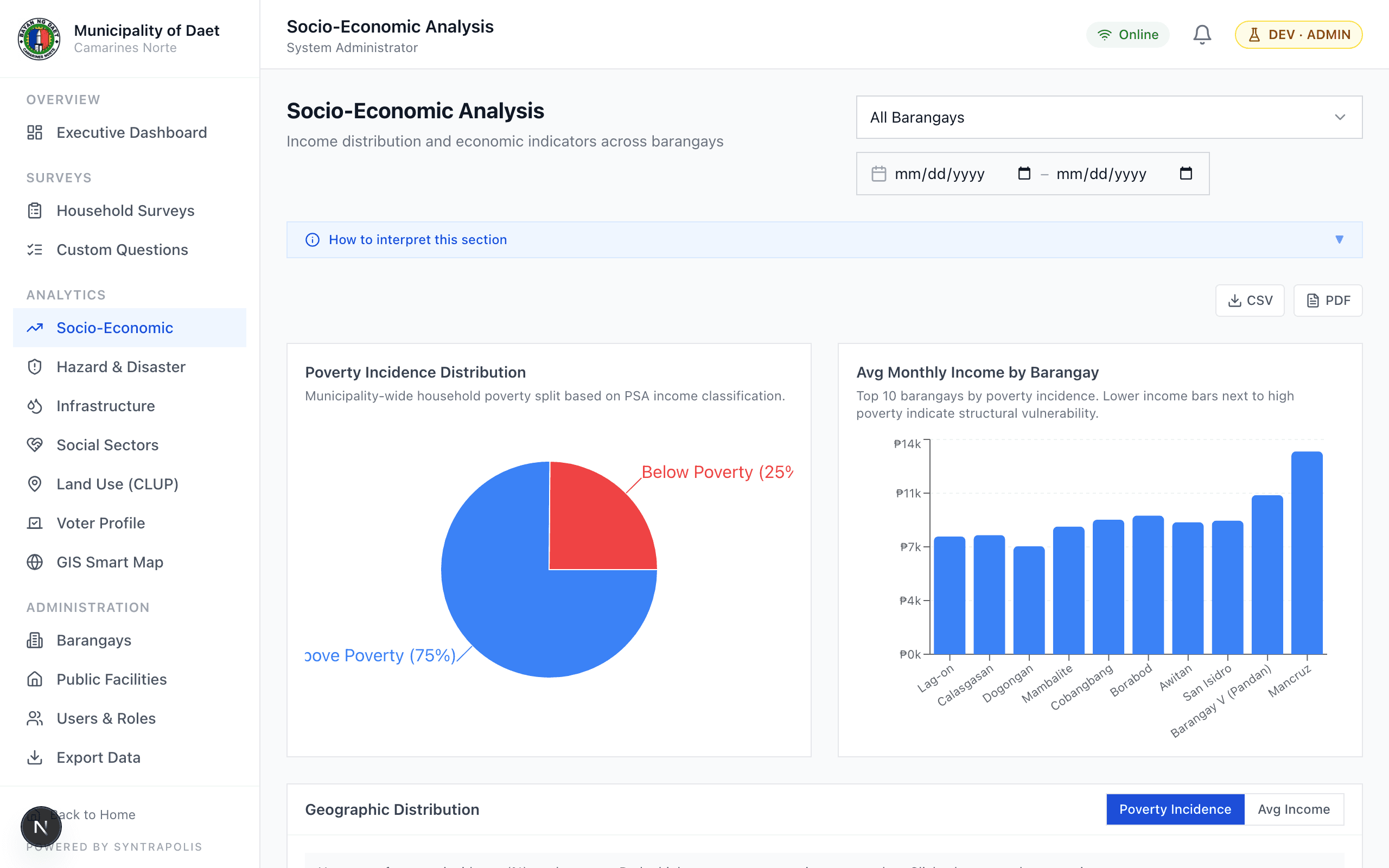
Targeted Social Services
The right programs reach the right people.
Quickly identify 4Ps beneficiaries, PWDs, senior citizens, solo parents, and out-of-school youth. This makes service delivery faster and more accurate.
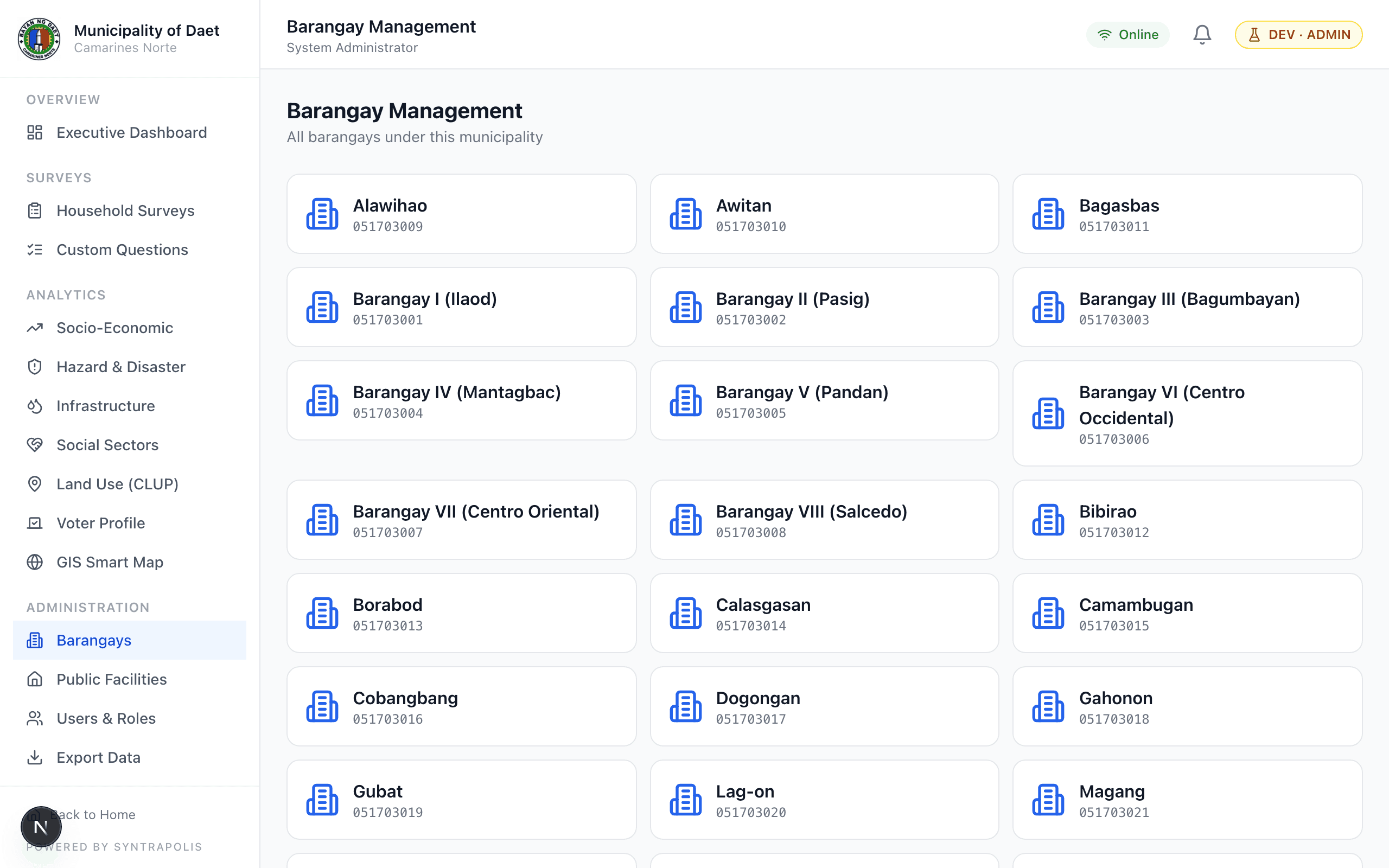
Secure, Role-Based Access
Everyone sees what they need — nothing more.
Each user only sees what they are allowed to access. Built-in tracking ensures accountability and proper handling of data at all levels.
Procure the Entire Command Center or Target Specific Vulnerabilities
Adopt the full SyntraPolis system for complete coverage, or select specific modules based on your LGU’s immediate needs. All options align with your Annual Investment Plan.
Enterprise Command Deployment
Achieve full compliance, accurate welfare targeting, and centralized oversight across all barangays. This reduces risks related to audits and administrative issues.
- Full-Spectrum 13-Module Audit Shield
- Unlimited Executive & Department Seats
- White-Glove LGU Implementation & Training
- Priority SLA for Executive Briefings
- End-to-End Migration of Legacy Records
Targeted Risk Mitigation
Address urgent concerns such as failing SGLG metrics, disputed lists, or disorganized DRRM data. You can expand the system gradually when ready.
- Deploy Specific High-Risk Modules
- Instant Upgrade to Enterprise Command
- Flexible Quarterly or Annual Appropriation
- Bank-Grade Encryption & Role-Based Access
- Dedicated Module-Specific Onboarding
The next COA audit,
SGLG evaluation, and typhoon deadline
are already on the calendar.
Each of the 13 modules is designed to solve common LGU challenges, from data validation to disaster planning. You can review each module to understand the problem it addresses and how it helps.
An Engine That Anticipates Administrative Friction
SyntraPolis structurally integrates Agentic AI and Retrieval-Augmented Generation that bypasses generic chat interfaces to deliver targeted, executive-level municipal foresight—validating compliance, auditing welfare bases, and auto-compiling statutory directives securely.
Executive Data Assistant
Query your municipal database in plain language. Unearth multi-layered cross-agency metrics instantly without waiting for IT to construct complex SQL queries.
Automated Compliance Drafting
Monthly situational reports and LPRAT inputs are autonomously drafted and fact-checked against live structural data, prepared explicitly for executive signature.
Early Vulnerability Detection
Machine learning models identify households spiraling toward the poverty threshold before the next PSA CBMS cycle, triggering proactive LGU interventions.
Pre-Disaster Logistics Planning
Cross-references real-time PAGASA trajectories with hyper-local household fragility markers, auto-generating exact prepositioning logistics for the MDRRMC.
Budget Optimization Analytics
Algorithmically flags inefficiencies between barangay resource allocations and their actual measured deficits—optimizing the Annual Investment Program flawlessly.
Voice-to-Data Field Reporting
Field enumerators rapidly dictate demographic profiles into mobile terminals; AI structures, validates, and aligns the spoken data into strict DILG formatting.
Automated Data Auditing
Continuous autonomous audits identify and flag statistical anomalies, duplicate ghost entries, and geographical conflicts before they ever reach the executive dashboards.
Policy Impact Simulation
Model how proposed multi-million peso infrastructure budgets will quantitatively affect the LGU's SGLG metrics before a single public peso is appropriated.
Seamless National Integration
Secure, AI-assisted bridges synchronize municipal records directly with DSWD NHTS and PhilSys architecture, executing faultless two-way institutional compliance.
Citizen Feedback Analysis
Aggregates diffuse input from barangay assemblies, citizen SMS, and physical helpdesks into structured, actionable governance insights through advanced NLP.
These AI capabilities extend the platform through large language models, vector databases, and government data APIs — all governed by LGU data ownership and data privacy principles.
Ready to Transform How Your LGU Governs?
Whether you want to deploy the full platform or start with a single module, our team will walk you through options, pricing, and implementation — at no obligation.
Developed by Ph413 IT Solutions · Powered by SyntraPolis
Enter by Your Role
Select your role to access the dashboard tailored to your responsibilities.